
Why Walers Are Stubbed Out During Shoring Construction
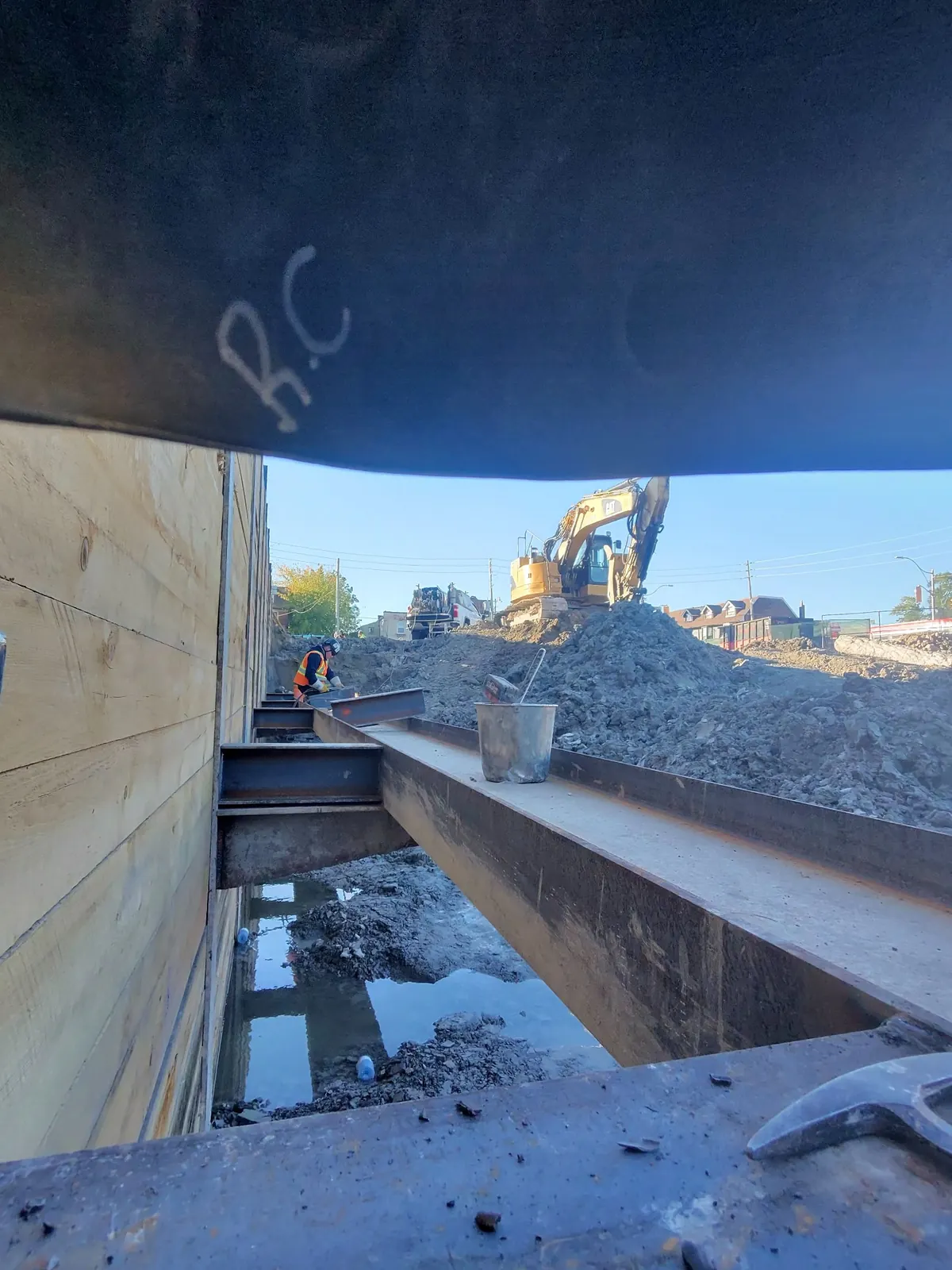
Why sections of shoring walers are intentionally left short or temporarily interrupted to accommodate concrete forming and later connection work.
Field knowledge for construction professionals. Connection design, fabrication, welding and acceptance must follow project-specific approved drawings, procedures and inspection requirements.
What does a stubbed-out waler mean?
On some excavation support projects, a waler is intentionally terminated short of an area where another trade needs temporary access. The visible steel may look unfinished, but the arrangement can be part of an approved construction sequence. It should not be treated as a universally acceptable detail: the shoring engineer must establish the configuration, any temporary conditions and the point at which a continuation can be connected.
Making room for concrete forms
One reason for this sequence is to provide clearance for concrete forming as the permanent structure advances. A continuous steel member installed too early could interfere with forms, reinforcing steel or the working space required to place concrete. A planned stub-out can help the construction team coordinate temporary works with the permanent structure.
Where field welding enters the sequence
When the project reaches the appropriate stage, a welding crew may be asked to install a designed extension or connection assembly. The work could involve preparation of existing steel, fit-up of additional members and welding to the approved detail. Access can be significantly different after formwork is erected, so the contractor should schedule the operation before closing off critical work areas.
Important sequencing questions
Who authorizes the temporary condition? When is the extension required? What supports the excavation during each stage? Which drawings govern the connection and who inspects it? These are coordination questions for the contractor and the responsible engineer. Field welders should not make structural sequencing decisions on their own.
What photographs can explain
A photo of a short-ended waler can help an estimator or site supervisor visualize the access issue. But a photograph does not establish the temporary load path, adequacy of a splice or permission to remove steel. Always refer to the project-specific engineered shoring plan.
Planning a shoring welding scope?
Share approved connection drawings, quantities, access information and your schedule so the scope can be reviewed.
Explore related welding services →